EWA Publishes Position Paper on European Sheep Wool, Rangelands and Pastoralism
13.10.2026
13 October 2026 | European Wool Association (EWA) AISBL
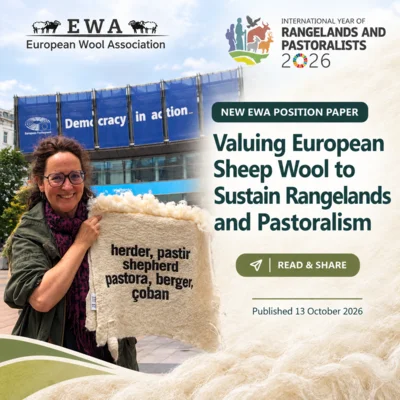
To mark the arrival of the Wool March in Brussels on 13 October 2026, the European Wool Association (EWA) has published its new position paper, “Valuing European Sheep Wool to Sustain Rangelands and Pastoralism”.
Prepared as EWA's contribution to the International Year of Rangelands and Pastoralists 2026 (IYRP 2026), the paper highlights the close relationship between European sheep wool, pastoral farming systems, biodiversity, rural livelihoods and cultural heritage.
Recognising the Value of European Sheep Wool
European sheep wool is more than a natural fibre. It is an integral part of sheep farming and pastoral systems that contribute to the management of landscapes, the conservation of native sheep breeds and the vitality of rural communities.
However, across Europe, sheep farmers face increasing challenges in finding economically viable outlets for their wool. Limited collection infrastructure, insufficient sorting and grading capacity, gaps in processing facilities and fragmented markets often prevent this valuable natural resource from reaching suitable applications.
EWA emphasises that the future of European sheep wool cannot be considered separately from the future of sheep farming and pastoralism.
Restoring value to wool can help strengthen farm resilience, support regional economic activity and contribute to the continued management of Europe's pastoral landscapes.
Six Priorities for European Action
The position paper identifies six areas requiring coordinated action:
Recognise sheep wool in pastoral and rural development policies, including relevant biodiversity, agricultural and bioeconomy strategies.
Establish a reliable European evidence base covering wool production, fibre characteristics, markets and processing capacity.
Strengthen collection and processing infrastructure, particularly the essential first stages of the wool value chain.
Match different wool characteristics with suitable applications and markets, recognising the diversity of European sheep breeds and wool types.
Address unnecessary regulatory barriers that hinder the collection, processing and sustainable use of sheep wool.
Strengthen skills, cooperation and economic returns for sheep farmers, supporting more resilient and connected European wool value chains.
From the Wool March to European Policy
The publication coincides with the final gathering of the Wool March Brussels 2026, an initiative that has brought together shepherds, sheep farmers, wool specialists, researchers, designers, artists and organisations throughout its journey from Texel to Brussels.
EWA has supported the initiative since March 2026, when Wool March initiator Cynthia Hathaway introduced the project during an EWA Special online event.
The Wool March has helped bring greater public attention to the people, knowledge and landscapes behind European wool. EWA's position paper builds on this momentum by setting out concrete priorities for recognition, cooperation and policy action.
The European Wool Association calls on policymakers, agricultural organisations, researchers, industry representatives and stakeholders throughout the wool value chain to work together to strengthen the future of European sheep wool and pastoralism.
Read the EWA Position Paper
Valuing European Sheep Wool to Sustain Rangelands and Pastoralism
European Wool Association (EWA) AISBL | 13 October 2026
Read and download the full EWA Position Paper (PDF)
EWA encourages members, partner organisations, researchers, policymakers and all those interested in the future of European wool to read and share the publication.
Further information: European Wool Association
Veranstalter
European Wool Association
Boßlerstraße 1
73119 Zell u. A.

E-Mail:
europeanwoolassociation.org
 E-Mail: